

Arizona Museum of Natural History isn’t living up to its potential and could be a cultural hub that drives economic development to Mesa and put the city on the global map.
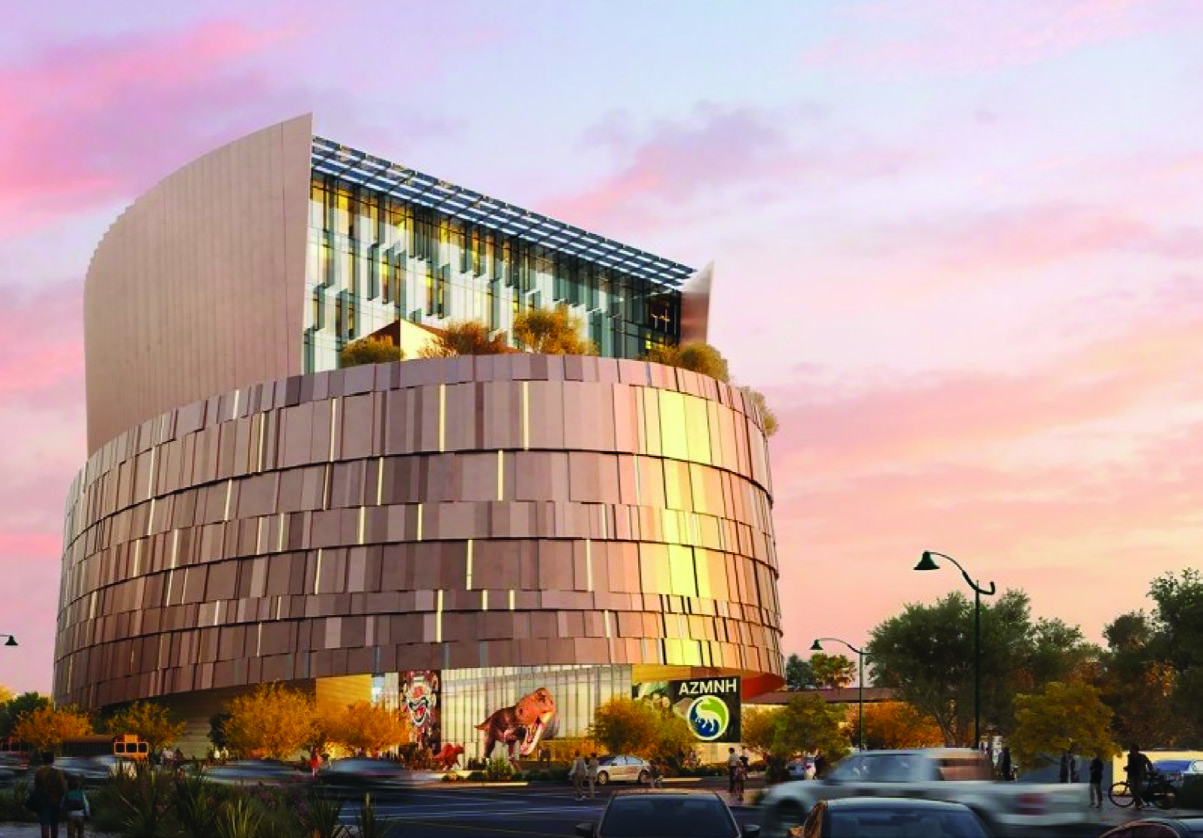
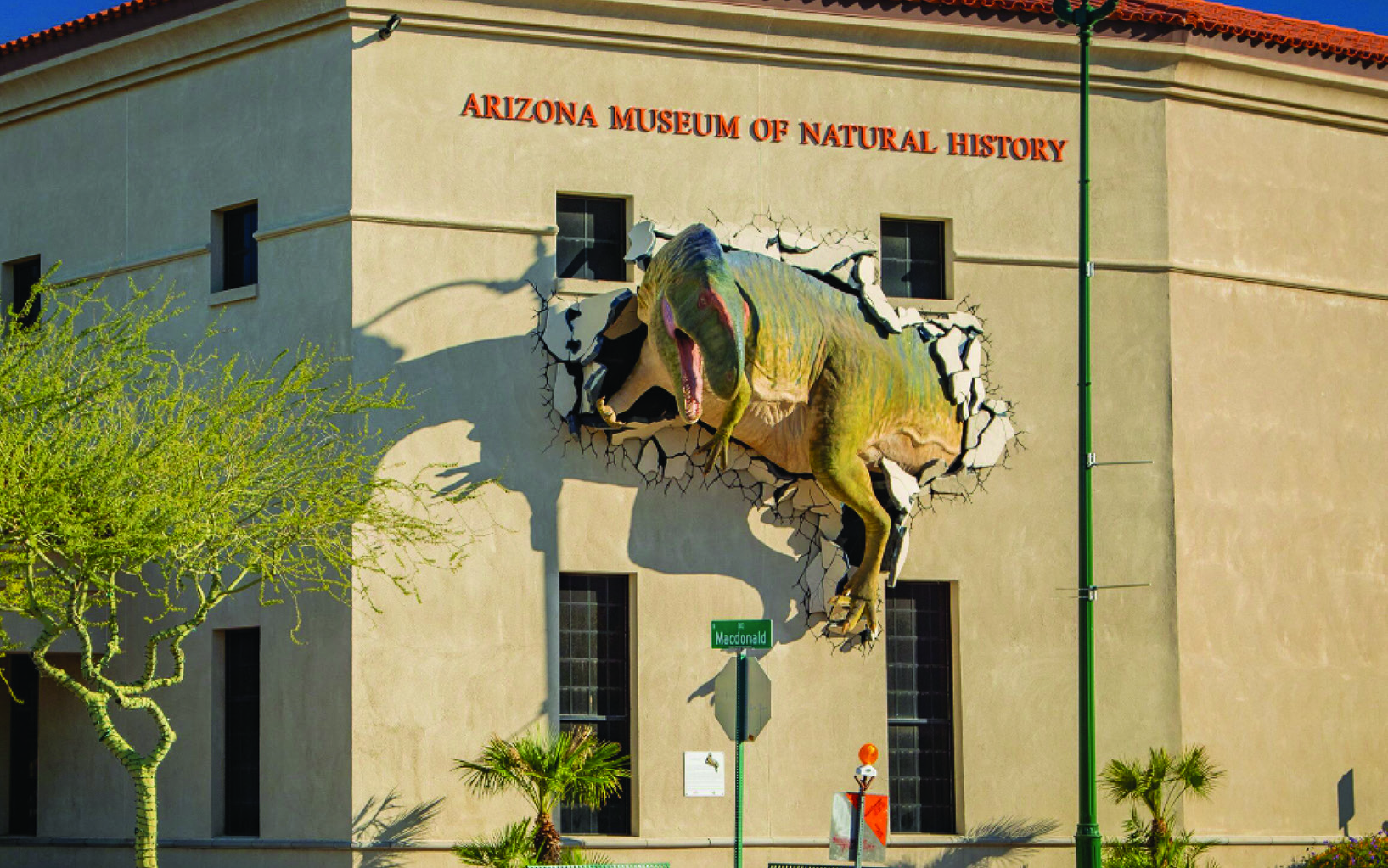
Council recently agreed to move forward on a plan that calls for tearing down the city-owned museum downtown and replacing it with a much larger building as part of a mixed-use development with a boutique hotel and retail and dining amenities.
It agreed to spend $6 million over the next two years to flush out the concept that could cost $300 million to implement.
“Our vision is to build something that is deeply Mesa, undeniably Amazonian and globally significant,” said Simon Tipene Adlam, the museum’s director.
“What you’re going to see is globally groundbreaking. It is incredibly unique as a self- sustaining economic engine.
“It is going to inspire our residents and future generations. It’s going to drive visitation, private investment and importantly for future generations, job creation and work pathways.”
The venue, the largest city-owned natural history museum in the country, is housed in Mesa’s former city hall, which was built in 1937 and has undergone a number of expansions since then.
It draws 175,000 visitors annually and generates $1.8 million a year from gate revenue and donations to supplement city funding. According to Adlam, the museum’s cost recovery is around 70-80%, which is “outstanding in government.”
The museum has the brand potential, the market and the audience to be a topvalue attraction, according to Spencer Downey, senior financial analyst for Gallagher & Associates.
“It is in the fastest growing residential market in the country, one of the fastest growing tourism markets in the country, and the fastest growing STEM economy in the country,” he said. “But currently, the building and the revenue model are holding the museum back from truly maximizing the return on this project’s investment.”
Downey said the museum’s current 66,000-square-foot footprint has capped its ability to grow visits, revenue and impact. Its annual visits represent just over 7% of the Valley’s total potential audience, he added.
“The building currently lacks the amenities and visitor amenities and revenue-generating spaces that are needed to maximize the return on investment,” Downey continued. “Those spaces are things like private event space, food and beverage amenities, a gift shop that is optimized to capture a greater share of retail, classroom and program spaces and staff and support spaces.”
A new, 118,000-square-foot building with four levels and a rooftop restaurant and observatory would accomplish that, he said.
“Through a public-private partnership the museum can generate and drive commercial investment into much-needed hotel space rooms, oneof-a-kind restaurant and commercial spaces, retail offerings and drive greater demand and visitation to Mesa than just the museum could on its own,” Downey continued.
He said it could become “an anchor in the downtown core” that could “drive greater visitation to Mesa and create longer trips for those tourists who are already here.
“Cultural tourists spend on average nearly 40% more per day and stay 22% longer than the average tourist,” Downey noted. “We are in a market that has a very active, engaged tourism base. These tourists are participating in things like cultural entertainment, shopping (and) nightlife activities that are at a greater rate than the average market in the United States.”
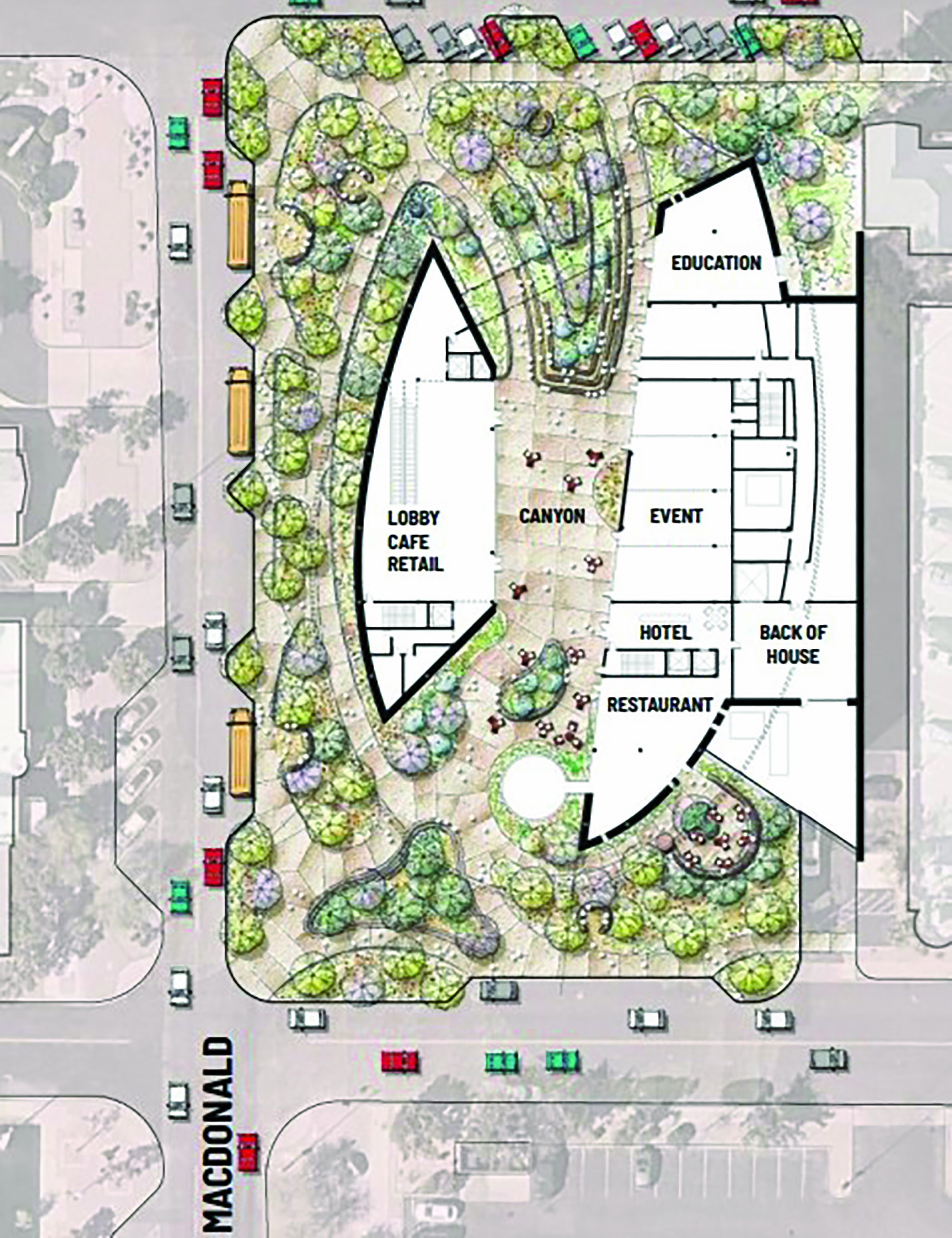
The total footprint for the proposed new museum comes to 288,000 square feet and includes 100,000 feet for the hotel, 70,000 square feet for retail and restaurant tenants and 10,000 square feet for outdoor space. The museum also would use “double height spaces” to accommodate larger exhibits.
“What that will do is allow us to take AZMNH today, which is a museum in a big market but captures a relatively low percentage of its total potential audience, and transform it to be a museum that in a big market and captures a greater share of that total potential audience,” Downey said.
“We believe the potential and the upside is even greater than what we project here.”
According to Downey, the museum could capture 515,000 to 630,000 visitors and almost twice as many with the hotel, retail, dining and public events in the mix.
Downey cited Natural History Museum of Utah, which underwent transformation and saw its attendance grow over three times.
According to Downey, a new museum in Mesa would lift the city’s quality of life and become a draw for future residents and corporations looking to relocate to the Valley.
“We want those jobs and we want the tax revenue,” he said. “But it’s really important because it’s the first step in developing high-impact partnerships that will allow us to create direct pipeline from this museum and the students that it will serve and educate and inspire and create a pipeline to future scientists, engineers and workforce of the Valley’s STEM economy today and of the future.”
Project vision
Brian Farling, principal and co-owner of Jones Studio, said the building’s architecture was inspired by natural and local materials.
The structure also would employ an “airplane hanger-style door” that opens the space, according to Farling.
“You can imagine the building opening up at the ground level and offering sort of this shady respite for people to enter into,” he said. “And you’re also greeted by a giant dinosaur and multiple dinosaurs as you go further in.”
Each floor would tell a story with the first level focused on the theme of origins, talking about how the earth comes alive and the second level depicting the Mesozoic Era or age of dinosaurs, according to Claire Brown, Gallagher’s creative director.
Level 3a would showcase the Cenozoic Era or Age of Mammals and Level 3b, “living memory of the recent past,” she said.
“As you move through the building, moving upwards, you are traversing time and space as well,” said Brown. “This is the story of 4.5 billion years and as you move up through the floors of the museum, through those double-height spaces, you will begin to learn the full history of the earth.”
The latest technology would be integrated throughout the museum, offering ways to explore the collections through digital access, Brown added.
According to Brown, two surveys and an in-person event showed strong public support for the project. The public also wants more adult-focused programming while maintaining offerings for children, she said.
“In order for this institution to have a multi-generational impact over many, many decades, the institution needs to be offering events and programming and spaces that feel comfortable to visitors across their whole lifespan, not just until they turn 13,” Brown said.
“We want to reach across generations through the physical design and programming. This is not going to be a typical museum. We will not develop a standard museum plug-and-play development.”
Funding model
The project is proposed to be funded equally through philanthropic dollars, a city bond and private investment.
“We’re working from a $300-million project scenario and looking at a funding strategy that has three legs,” said Laura MacDonald, a certified fund raising executive.
Those legs would be “public investment, should you elect to proceed, private investment, private commercial investment in the hospitality and hotel portions of the project, and private philanthropy.”
Downey said the museum currently operates with hardly any philanthropic support and needs to tap into this revenue source that every other museum in the country is using.
“Last year, I believe it had $570,000 in contributed revenues but if we look at the rest of the Valley, that average was $7.8 million in contributed revenues,” he said. “That’s not just in the Valley – that’s across the country.
According to MacDonald, for every public dollar that might be invested, the potential exists to attract two additional dollars from the private sector.
She said the latest available data show Americans gave $592 billion to nonprofits in 2024 – 35 times the annual budget of the state. In Arizona, charitable giving is somewhere between $5 billion and $7 billion and in Phoenix metro, it’s $3.6 billion to $6 billion, she said, adding that the state has about 1,000 foundations holding $7 billion in assets.
“Donors who are attracted to education, to public society benefit, to workforce development, all of those dollars can be driven to a project like this,” Mac- Donald said, adding, “It is possible to attract funding from outside of the state and region also for a project like this.
“Sports and theme parks attract about 450 million visitors a year. Museums attract 850 million visitors a year.”
She proposed the city hire frontline fundraisers and back-of-the-house staff to undertake a capital campaign for the project, partnering with the museum’s foundation.
“For every dollar that might be invested in fundraising, you will realize in a mature operating model, $3 to $6 in return on that investment for an annual campaign, your annual operating budget,” MacDonald said.
“You’ll also realize much more than that, as much as 10 times or more your investment in a capital campaign because of the scale, because of the wonderful vision and because of the way that it really targets the top of the economic ladder.”
Mayor Mark Freeman noted there are 22 native tribes in Arizona, all of which “should be a partner in this process.”
Councilman Rich Adams said it will be easier to get donations from Mesa residents, stating that getting buy-in from people elsewhere in Arizona “might be the real challenge – to see it as an Arizona treasure.”
Councilwoman Dorean Taylor said she agreed with the mayor that the terrace event space looking south to Main Street should be facing toward the mountains instead.
“This is a museum of natural history,” Taylor said.
“We should be looking at Arizona’s natural terrain, appreciating all the beauty that it affords us,” she said, adding: “I’m pretty passionate about the fact that if we’re looking at proposing an incredibly large project about Arizona’s natural history, one of the things that we should be really almost myopically thinking about should be our centered view of our mountains. They’re what draw people here from all over the world.”
According to Farling, the observatory and a couple of terraces on the north side of the building would afford visitors sights of the mountains.
Taylor also asked if there are other cities interested in contributing toward the museum.
“The fundraising strategy would actually happen over this next year,” said Candace Cannistraro, deputy city manager. “So we haven’t reached out to anybody in any relationship at this point.”
Taylor added that she wanted to see creationism featured in the new museum.
She cited three sources, including the Gallup Poll that showed “71% of Americans are still strong believers that there is a religious affiliation with the creation of the world.”
“When we’re looking at only one from a Darwinian theory, we are basically excluding the majority of Americans,” she said. “I am OK with considering this expansion but on one premise and I’m going to lock down on this hard. There has to be more than one theory represented in a natural history museum.
“And that would include creationism because we are essentially excommunicating the idea of creationism when we say we’re only going to look at this from an evolutionary perspective. “They are both theories and they both must be represented fairly.”
Councilwoman Alicia Goforth said she wanted to see more detail on how that $6 million in one-time revenues will be spent; City Manager Scott Butler said that staff will get that information.
Freeman said that he was recently at the nation’s capital and visited the Smithsonian National Museum of Natural History and was overwhelmed by it.
“We can’t compete with that,” Freeman said. “But what we can do is elevate Mesa to another higher standard with this type of architecture and development.
“If all this comes into play, it will really create a more vibrant downtown than any of our neighboring communities will ever have and expect.”
Councilwoman Jenn Duff did not attend the study session but sent a letter of support to be read into the record.
“Over the past three and a half years, this has evolved from a $180-million concept into a roughly $300 million mixed-use destination museum, hotel, retail and restaurant,” Duff said.
“We’re building a global, competitive destination anchored by 40-plus years of irreplaceable research, collections, intellectual property, the facility that will drive overnight stays, new jobs and tax revenue while reducing long-term resilience on the general fund.”
“This is our opportunity to believe in ourselves, to invest in another world-renowned project and to let Mesa shine on a global stage once again,” she said.
Next steps
With council’s approval to move forward, over the next two years the city and consultants are expected to accomplish a number of assignments.
They include an economic impact study, developing a fundraising strategy and performing architecture and site design work that will include the conceptual cost estimate.
“This is important,” said Luis Ruiz, arts and culture director. “This is an opportunity for us to consider how a major cultural institute can serve Mesa’s residents, strengthen downtown and contribute to the city’s broader vision for a thriving and prosperous community.”